Quick answer
Ozone is the right tool for unoccupied spaces, fast turnaround, severe contamination, and tighter budgets. Hydroxyl is the right tool for occupied spaces, sensitive materials, continuous treatment over days, and applications where ozone is restricted by code or insurance protocol. Both technologies destroy odor molecules, mold spores, MVOCs, and airborne biological contaminants — but they do it through different chemistry, on different timelines, and at different price points. Most professional restoration contractors who do this for a living keep both in their fleet.
This guide is written by Bio3Blaster, a commercial ozone generator manufacturer in business since 2009. We make ozone and we offer a professional hydroxyl line for occupied-space treatment. Because we work with both technologies every day, we’d rather you have honest information about the choice than a sales pitch — if your job calls for ozone, we’ll tell you, and if it calls for hydroxyl, we’ll tell you that too.
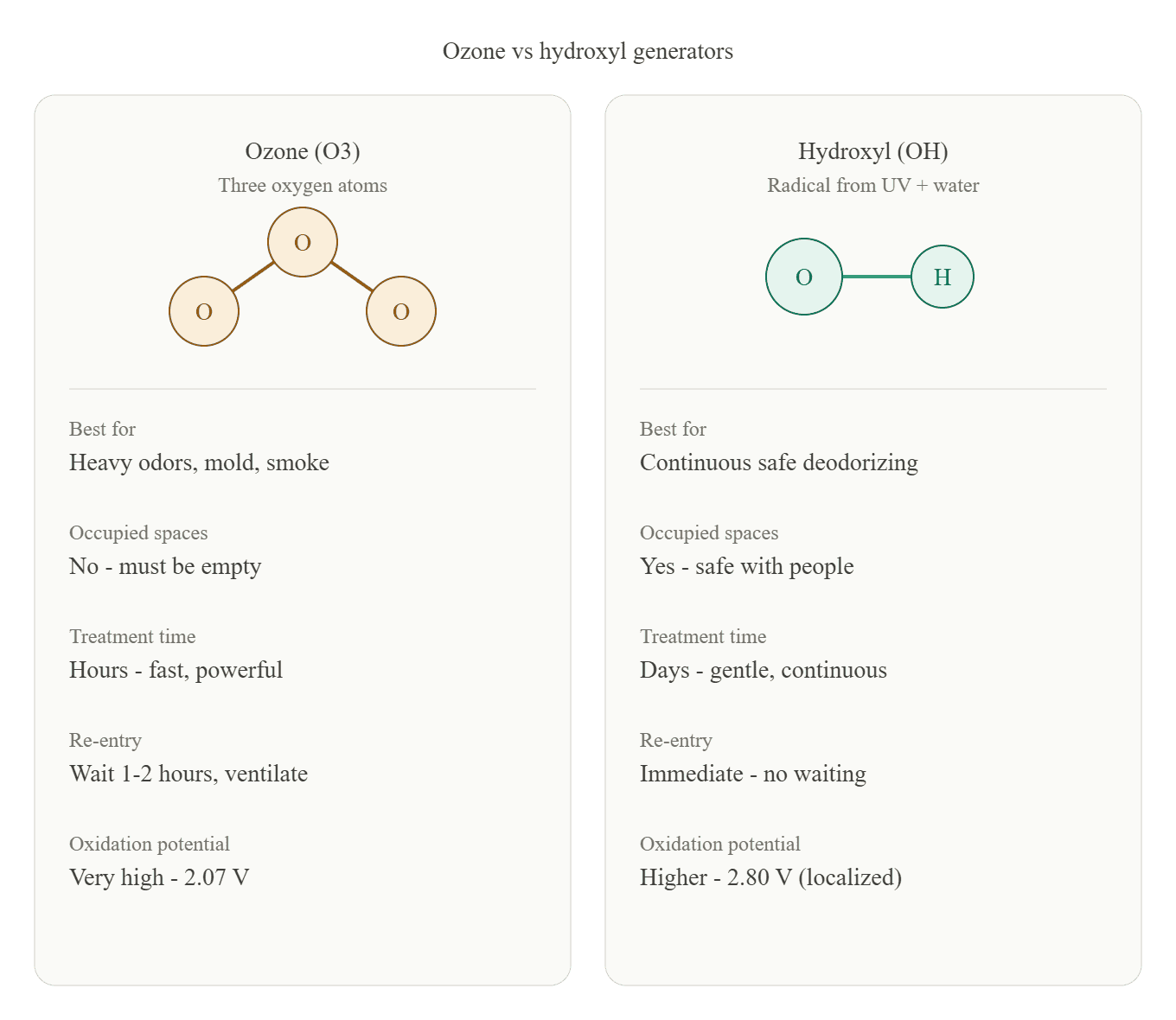
The fundamental chemistry difference
Both technologies belong to a family of remediation methods called advanced oxidation processes (AOP). Both work by attacking organic molecules — odor compounds, biological cell walls, VOCs — at the molecular level and breaking them apart. The difference is which oxidizing species does the work and how it gets produced.
Ozone (O₃) is a triatomic oxygen molecule. The third atom is loosely bonded, making the molecule aggressively reactive. Ozone gives up that extra atom on contact with organic compounds, oxidizing them and reverting to ordinary O₂. Ozone generators produce O₃ directly through corona discharge — passing dry air or oxygen through an electrical field that breaks O₂ apart and recombines it as O₃. The output is a steady flow of ozone gas that fills the space.
Hydroxyl radicals (·OH) are even more reactive than ozone — they sit higher on the oxidation potential scale. But they exist for fractions of a second before reacting with whatever is nearby. Hydroxyl generators don’t produce a steady stream of stable molecules the way ozone generators do. They produce hydroxyl radicals on the fly through photocatalysis: UV-C light shining on a titanium dioxide (TiO₂) catalyst in the presence of water vapor and oxygen. The radicals form, react, and disappear continuously — destroying contaminants in microseconds and leaving behind harmless byproducts (mostly CO₂ and water).
This single mechanical difference — stable gas vs ephemeral radical — drives every other distinction between the two technologies.
Side-by-side comparison
| Property | Ozone (O₃) | Hydroxyl (·OH) |
|---|---|---|
| Oxidation potential | 2.07 V | 2.80 V |
| How it’s produced | Corona discharge through air or oxygen | UV-C + TiO₂ catalyst + humidity |
| Lifetime in air | ~30 minutes (half-life) | Microseconds |
| Concentration during treatment | 8–12+ ppm (shock) | Far below 1 ppm at any given moment |
| Occupied-space safe | No | Yes |
| Treatment time | Hours (single shift) | Days (continuous) |
| Required ventilation after treatment | Yes, 30–60 min | None |
| Sensitive to humidity | Less sensitive | Requires humidity to function |
| Damages rubber/latex over time | Yes (with prolonged exposure) | Minimal |
| Equipment cost (typical contractor unit) | $533 – $2,500 | $2,500 – $7,000+ |
| Consumables | Plate cleaning every 1–5 years | UV bulbs, TiO₂ panels (annually) |
| Best for severe odors | ★★★★★ | ★★★★ |
| Best for occupied jobs | ★ | ★★★★★ |
When ozone is the right tool
Ozone wins on three things: speed, power, and price. If those are what your job needs, it’s the right call.
Restoration jobs where occupants have relocated. Fire damage, severe smoke, biohazard remediation, post-flood mold treatment. The structure is empty, you have a service window of hours not days, and the contamination level is severe. Ozone at shock concentration of 8–12 ppm for 2–4 hours destroys MVOCs, smoke odors, and biological contamination at a level hydroxyl simply cannot match in the same timeframe.
Auto detailing and dealer reconditioning. Vehicles are unoccupied during treatment by definition. Treatment cycles need to be 30–60 minutes for the unit economics to work. Ozone is the standard equipment for this industry for a reason — nothing else gets a smoke-damaged trade-in dealer-ready in under an hour.
Property turnover between tenants. Apartments, vacation rentals, hotel deep-cleans during low season, student housing. Empty unit, fast turn, severe odor load from previous occupants. A 2–4 hour ozone shock and a 1-hour ventilation cycle prepares the unit for showing the same day.
Cannabis cultivation, processing, and retail. Grow rooms, drying rooms, post-trim odor control. High-volume industrial settings where ozone’s per-square-foot cost and treatment speed matter.
Crime scene and trauma cleanup. Decomposition odors at concentrations that nothing short of shock-level ozone treatment will neutralize.
HVAC duct sanitization in commercial buildings. Run ozone through the duct system over a weekend, ventilate Monday morning, occupants return to a sanitized system.
Budget-constrained operations starting out. A new restoration contractor can outfit a truck with an 80,000 mg/h ozone generator for under $2,000. The equivalent hydroxyl machine costs three times that. The ROI on ozone equipment is faster.
When hydroxyl is the right tool
Hydroxyl wins on the one thing ozone fundamentally can’t do: operate safely in occupied spaces. If your job needs that, no amount of ozone power matters.
Occupied homes during remediation. Family can’t relocate, has to stay in the house during the work. Hydroxyl runs continuously over 3–7 days at concentrations far below human exposure thresholds, treating the air without forcing relocation. This is increasingly common in insurance-driven residential restoration where additional living expense (ALE) is a major cost line.
Hotels and short-term rentals during operation. Property can’t be taken offline. A water-damaged room next to occupied rooms needs treatment that can’t migrate as ozone could under doors and through HVAC returns. Hydroxyl operates safely in adjacent units without affecting guest experience.
Hospitals, clinics, and medical facilities. Patient care continues during environmental remediation. Ozone is incompatible with the regulatory environment in healthcare; hydroxyl is the accepted technology.
Food production and food service facilities. Operations continue. FDA and local health authority guidance permits hydroxyl in occupied food-contact environments where ozone would not be allowed.
Sensitive materials present. Live plants, certain electronics, rubber gaskets that can’t be removed, latex products, art collections, leather goods, archive documents. Ozone exposure over hours degrades these materials. Hydroxyl, operating at trace concentrations, does not.
Fire restoration on occupied commercial property. A small office fire where the rest of the building stays operational. Ozone shock would force evacuation of adjacent suites. Hydroxyl works in the affected area while neighbors continue working next door.
Schools, daycares, and assisted-living facilities. Population vulnerabilities (children, elderly, immunocompromised) and operational constraints (can’t close for a week) make hydroxyl the only viable choice.
Insurance protocols that mandate occupied-space treatment. Some carriers, after losses where ALE costs ran high, now specify hydroxyl-only protocols for residential mold and water restoration. Know your local carrier requirements before bidding.
California facilities with CARB-related restrictions. Some Class B occupancies in California restrict ozone equipment under CARB rules. Hydroxyl is unaffected.
Use case: side-by-side decision matrix
| Scenario | Ozone | Hydroxyl | Notes |
|---|---|---|---|
| Vacant rental turnover | ★★★★★ | ★★★ | Fast turn, ozone wins on cost and speed |
| Occupied homeowner-stays restoration | – | ★★★★★ | Ozone unsafe, hydroxyl is the only option |
| Mold remediation (post-removal) | ★★★★★ | ★★★★ | Both work; ozone faster, hydroxyl gentler on materials |
| Auto detailing / dealer reconditioning | ★★★★★ | ★★ | 60-min turnaround needs ozone speed |
| Hotel water damage during operation | – | ★★★★★ | Adjacent units occupied, ozone unsafe |
| Fire restoration unoccupied structure | ★★★★★ | ★★★ | Severe smoke needs ozone power |
| Fire restoration occupied commercial | ★★ | ★★★★★ | Operations continue |
| Healthcare environmental cleanup | – | ★★★★★ | Regulatory only allows hydroxyl |
| Cannabis operations | ★★★★★ | ★★★ | Industrial volume, unoccupied |
| Cigarette smoke remediation | ★★★★★ | ★★★★ | Both effective; ozone faster |
| Crime scene / trauma cleanup | ★★★★★ | ★★★ | Severe biological contamination |
| Pet odor in occupied family home | ★★ | ★★★★★ | Family stays during work |
| HVAC duct cleaning commercial | ★★★★★ | ★★★ | Weekend treatment, unoccupied |
| Food production facility | – | ★★★★★ | Operations + regulatory |
| Storage facility musty odor | ★★★★★ | ★★★ | Unoccupied, large volume, ozone wins on cost |
Cost comparison: equipment, consumables, and total cost of ownership
Equipment cost is the most visible difference, but it’s not the whole picture.
Initial equipment investment. A professional-grade ozone generator suitable for restoration contractor use runs from roughly $533 for an entry-level 20,000 mg/h unit to about $2,500 for an industrial 80,000–100,000 mg/h unit with a 1,850+ CFM blower. A hydroxyl generator with comparable treatment capacity typically runs from $2,500 for a small unit to $7,000+ for industrial-grade equipment.
Consumables. Ozone generators have minimal consumables. Quartz/ceramic dielectric cells in professional units last five to seven years under normal contractor use. Plate cleaning takes minutes with a screwdriver. Hydroxyl generators consume UV-C bulbs (typically 8,000–10,000 hour lifespan, around $40–$120 per bulb) and TiO₂ catalyst panels or coatings (annually for heavy commercial use). Plan on $200–$400 per year in consumables per heavy-use hydroxyl unit.
Treatment time as a cost factor. Ozone treats a 2,000 sq ft residence in 2–4 hours plus ventilation. Hydroxyl treats the same space in 3–7 days continuous. From a contractor’s labor and equipment-utilization standpoint, ozone allows two to four jobs per day where hydroxyl ties up a unit for the entire week. This isn’t a problem for the right job — occupied-space jobs simply cannot be done in 4 hours by anyone — but it’s a real consideration when comparing equipment ROI.
Power consumption. Ozone generators draw 200–800 watts during operation. Hydroxyl generators draw similar wattage but for a much longer duration. Over a week-long hydroxyl treatment, total energy cost is higher than a 4-hour ozone shock — small but worth noting on long-term billing.
Total cost of ownership for a working contractor over 5 years:
| Item | Ozone (typical fleet) | Hydroxyl (typical fleet) |
|---|---|---|
| Equipment (single unit) | $1,500 | $4,500 |
| Consumables (5 years) | ~$50 | ~$1,500 |
| Treatment time per typical residential job | 4 hours | 4 days |
| Jobs completed per unit per month | 12–20 | 4–7 |
| 5-year revenue capacity per unit | High | Moderate |
This is not an argument against hydroxyl — it’s a clarification that the two tools serve different markets at different price points. If your business is occupied-space restoration, hydroxyl’s slower per-unit throughput is offset by the fact that ozone simply can’t do those jobs at all.
What both technologies are good at
Despite all the differences, ozone and hydroxyl share a meaningful core of capabilities. Both:
- Destroy mold spores by oxidizing cell walls and rendering them non-viable
- Break down MVOCs (the compounds responsible for musty odors)
- Neutralize cigarette and cannabis smoke at the molecular level
- Eliminate pet odor compounds embedded in soft materials
- Penetrate porous materials (drywall, carpet padding, framing) where surface cleaning cannot reach
- Reach inside wall cavities, HVAC ductwork, and other hard-to-access spaces
- Leave no chemical residue after treatment (both revert to oxygen and water)
- Are chemical-free alternatives to traditional antimicrobial sprays
The decision between them is rarely about whether the job can be done. It’s about under what constraints — occupied vs unoccupied, fast vs slow, severe vs moderate — it’s being done.
Virus inactivation: ozone vs hydroxyl
Both technologies oxidize viral particles through the same fundamental mechanism that breaks down mold spores and bacterial cells — they attack lipid envelopes, protein capsids, and viral genetic material. The practical question for restoration contractors and facility managers is how each performs in real-world post-event remediation: empty offices after a flu outbreak, vehicles after a sick passenger, short-term rentals during cold and flu season, healthcare environmental cleanup, and biohazard scenes.
What the science shows. Both ozone and hydroxyl are classified as advanced oxidation processes with documented virucidal activity in environmental remediation contexts. Peer-reviewed environmental research documents ozone inactivation of common enveloped viruses (such as influenza and coronaviruses) at typical contractor operating concentrations given sufficient contact time. Hydroxyl radicals attack the same viral structures through similar oxidation pathways and have demonstrated inactivation in laboratory and field studies at the lower concentrations the technology produces. Important framing: these are environmental remediation tools used after an event in built spaces. Neither technology is a medical device, neither treats illness in humans or animals, and neither is a substitute for clinical infection control protocols. The use case is post-event property cleanup — not infection prevention or medical sanitization.
Where ozone wins on virus remediation:
- Concentration and speed. Shock-level ozone (8–12 ppm) achieves faster and more thorough viral inactivation than hydroxyl at its typical operating concentration. For an empty space that needs to turn quickly after a confirmed illness exposure, ozone’s higher concentration window finishes the job in hours.
- Penetration into porous materials. Ozone permeates into the same micro-spaces virions persist in — cushion seams, HVAC ductwork, headliner backing, drywall — at concentrations that drive full inactivation throughout the matrix, not just on exposed surfaces.
- Vehicle and small-space turnaround. Rideshare cars, rental vehicles, fleet trucks, and other small unoccupied spaces with a documented sick passenger return to service faster with ozone than with any other approach.
Where hydroxyl wins on virus remediation:
- Occupied-space operation. Schools during flu season, offices after a confirmed exposure, daycares, and other facilities that cannot be vacated. Hydroxyl operates continuously around people without exceeding any exposure threshold. Ozone at virucidal concentrations cannot be run in occupied spaces.
- Continuous viral-load reduction during ongoing exposure. A hydroxyl unit running in the background of an active environment reduces airborne viral load over days or weeks — relevant in healthcare, long-term care, eldercare, and other persistent-exposure settings.
- Sensitive equipment present. Hospitals, clinics, and laboratories with extensive electronic medical equipment can run hydroxyl during operations without the cumulative oxidative wear that prolonged ozone exposure would create.
Effectiveness side-by-side for common post-event remediation scenarios:
| Scenario | Ozone | Hydroxyl | Notes |
|---|---|---|---|
| Empty office after confirmed illness exposure | ★★★★★ | ★★★★ | Ozone faster, hydroxyl gentler on electronics |
| Rideshare or rental vehicle after sick passenger | ★★★★★ | ★★★ | 60-minute turnaround needs ozone speed |
| Short-term rental turnover during flu season | ★★★★★ | ★★★ | Vacant unit, fast turn |
| Active classroom or daycare during outbreak | – | ★★★★★ | Continuous treatment, occupied |
| Healthcare environmental remediation | – | ★★★★★ | Patients present, regulatory framework |
| Biohazard scene with confirmed pathogens | ★★★★★ | ★★★ | Severe contamination, unoccupied protocol |
| Long-term care facility, ongoing reduction | – | ★★★★★ | Vulnerable population, continuous |
The honest summary. For fast, severe virus remediation in unoccupied spaces, ozone is more powerful and finishes the job in a single shift. For continuous virus-load reduction in occupied spaces, hydroxyl is the only safe option. Both are used in professional environmental remediation. Neither is a medical device, neither treats illness, and neither is a substitute for clinical infection control. The right tool depends, as always, on whether the space is occupied and how fast you need to be done.
Specific case: rodent contamination and hantavirus. Restoration contractors increasingly handle rodent-contaminated properties — cabins, crawl spaces, attics, abandoned outbuildings. Hantaviruses are enveloped viruses spread through aerosolized rodent urine, droppings, and saliva. The CDC’s recommended cleanup protocol is well-established: ventilate the space for 30 minutes before entry, wear appropriate PPE, do not sweep or vacuum (which aerosolizes contaminated dust), wet-clean all surfaces with a 10% bleach solution or an EPA-registered disinfectant, double-bag waste, and follow the full protocol at cdc.gov.
After CDC-protocol cleanup is complete, ozone is sometimes used as a final step to address residual odor from rodent infestation in porous materials and structural cavities — drywall, insulation, framing, ductwork — that surface cleaning cannot fully reach. This is environmental odor remediation, not virus disinfection. Bio3Blaster ozone equipment is not EPA-registered against hantavirus or any other specific pathogen. CDC- and EPA-approved disinfectants registered for hantavirus are the primary line of defense. For contractors who do this work regularly, the workflow is: PPE → ventilation → wet bleach cleanup → physical removal of nesting material → ozone shock for residual odor. Each step has a job; ozone’s job is the last one.
Common misconceptions
“Hydroxyl is just a fancy ozone generator.” No. They produce different oxidizing species through different mechanisms. Hydroxyl radicals are more reactive but exist in much lower concentrations and shorter timeframes. The technologies are not interchangeable.
“Ozone is dangerous, hydroxyl is safe.” Oversimplified. Ozone at shock concentrations is hazardous and requires unoccupied-space protocol. Ozone at occupational exposure limits (under 0.1 ppm averaged over 8 hours) is the same air outside on a smoggy day. The danger is concentration, not the molecule. Hydroxyl is safer because the equipment is designed to produce concentrations that stay below human exposure thresholds — but that’s also why it works more slowly.
“Ozone is illegal.” No, ozone equipment is legal at the federal level for professional remediation use. Some states (notably California under CARB) have regulations on ozone air-cleaning equipment marketed to consumers — distinct from contractor-grade equipment used for periodic remediation in unoccupied spaces. Know your local rules.
“Hydroxyl is FDA approved.” Hydroxyl generator manufacturers cannot make medical or sanitization claims under FDA jurisdiction without device clearance. The technology is widely used in remediation; the regulatory status is about claims, not the technology itself.
“You need one or the other.” Most working professionals own both. The two tools serve different segments of the same overall remediation market. Specializing in only one limits the jobs you can bid on.
“Ozone destroys electronics.” Ozone at typical contractor concentrations does not damage modern electronics. It can degrade some rubber gaskets and certain types of natural rubber over prolonged exposure (8+ hours). This is rarely an issue at standard 2–4 hour treatment cycles. Hydroxyl is gentler with rubber components and is the safer choice for electronics-heavy environments.
“Hydroxyl works on every odor.” Hydroxyl is highly effective on most VOCs and biological odors. For severe smoke damage from a structure fire, ozone’s higher concentration and faster turnover often produces more complete results in a shorter time. Hydroxyl will get there too — it just takes longer.
Frequently asked questions
Can I use ozone and hydroxyl together? On the same job, in sequence — yes. Ozone shock during the unoccupied-space window after physical remediation, followed by hydroxyl during reoccupation if odors persist. On the same job, simultaneously — no, the chemistry interactions are not well-characterized and there’s no benefit over running them sequentially.
Is hydroxyl really safe to breathe during operation? Yes, when the equipment is operated within manufacturer specifications. Hydroxyl radicals exist for microseconds at concentrations well below the threshold of any health concern. You can stand next to a running hydroxyl machine and feel nothing. Ozone at shock concentrations would cause immediate respiratory irritation.
Does humidity affect either technology? Both, in different directions. Ozone production is slightly more efficient in dry air; in very humid air the corona discharge can degrade. Hydroxyl requires humidity to function — the photocatalytic reaction needs water vapor. Most hydroxyl generators have an integrated humidifier or a minimum ambient humidity spec.
Which is better for cigarette smoke odor? Both work. Ozone is faster and more thorough on heavily nicotine-saturated materials (headliners, drywall, carpet padding). Hydroxyl works but takes longer for severe cases. For light-to-moderate smoke odor in an occupied space, hydroxyl is fine. For a chain-smoker’s vehicle headed to a dealer auction next week, ozone.
Which is better for mold? Both attack mold spores and MVOCs. Ozone in a single 2–4 hour shock cycle achieves the same outcome as hydroxyl operating for 3–5 days — provided the space can be unoccupied. For mold in occupied homes, hydroxyl is the answer. For post-remediation final treatment in unoccupied spaces, ozone is faster.
Will my insurance cover hydroxyl treatment? Increasingly yes — especially in residential restoration where the carrier is paying ALE for displaced occupants. A hydroxyl protocol that keeps the family in the home eliminates the ALE line item, which often justifies the higher equipment cost on the carrier’s side. Verify with the specific carrier on each claim.
How do I know if my hydroxyl machine is working? Hydroxyl is invisible, odorless, and the radicals exist for microseconds — so you can’t see, smell, or measure them directly the way you can with ozone. Manufacturers publish specifications for their UV-C output and TiO₂ surface area; verify the unit is operating to spec via the bulb status indicators and runtime logs. Output testing is done in lab environments, not on jobsites.
Can I rent these instead of buying? Rental markets exist for both, particularly in disaster-restoration regions. Buying makes sense once you have steady utilization (4+ jobs per month). Rental rates run roughly $100–$250/day for ozone units and $200–$500/day for hydroxyl. The break-even on ownership is typically 60–90 rental-days per year.
What about combination machines that produce both? A small market exists. They work, but the trade-off is that you get a compromise unit on both sides — moderate ozone output, moderate hydroxyl capability. For professionals who do enough work to justify two separate units, two specialized machines outperform one combination unit at the same total cost.
How to choose: a 60-second decision tree
Ask yourself, in this order:
1. Will the space be occupied during treatment?
- Yes → hydroxyl
- No → continue
2. Is the contamination severe (fire, biohazard, heavy mold) or routine (light odors)?
- Severe → ozone (faster, more thorough)
- Routine → either works; pick on cost
3. What’s the time window?
- Hours → ozone
- Days → either; hydroxyl if there are occupants nearby
4. Are there sensitive materials (rubber, electronics, art, live plants) that can’t be removed?
- Yes → hydroxyl
- No → ozone
5. What’s your budget envelope per unit?
- Under $2,500 → ozone
- $2,500–$7,000 → either
- $7,000+ → either, with capacity to scale
If you answered “ozone” at any step where the constraint is hard (occupied space, severe contamination, hours-not-days), the answer is ozone. If you answered “hydroxyl” at any step where the constraint is hard (occupied space, regulatory restriction, sensitive materials), the answer is hydroxyl. Most jobs fall cleanly on one side or the other.
About Bio3Blaster
Bio3Blaster has been hand-building commercial ozone generators in Ohio since 2009. We hold US Patent #8685333 B2 and are BBB accredited. Our customers are restoration contractors, property managers, auto detailers, and commercial cleaning operations across the country.
We wrote this comparison because we’d rather customers buy the right tool than buy ozone when ozone is the wrong fit. If your typical job mix is unoccupied-space restoration, fast turnaround, severe contamination, or budget-constrained operations, our ozone line is built for you. If your work is consistently occupied-space residential, healthcare, or operating commercial environments, hydroxyl is the answer — and Bio3Blaster offers a professional hydroxyl line built specifically for that work.
Browse commercial ozone generators → https://professionalozone.com/shop/
Browse hydroxyl generators → https://professionalozone.com/hydroxyl-generators/
IAOPAC professional ozone contractor certification → https://professionalozone.com/iaopac/
Or call 1-800-240-8514 to talk through ozone equipment selection for your specific application.